
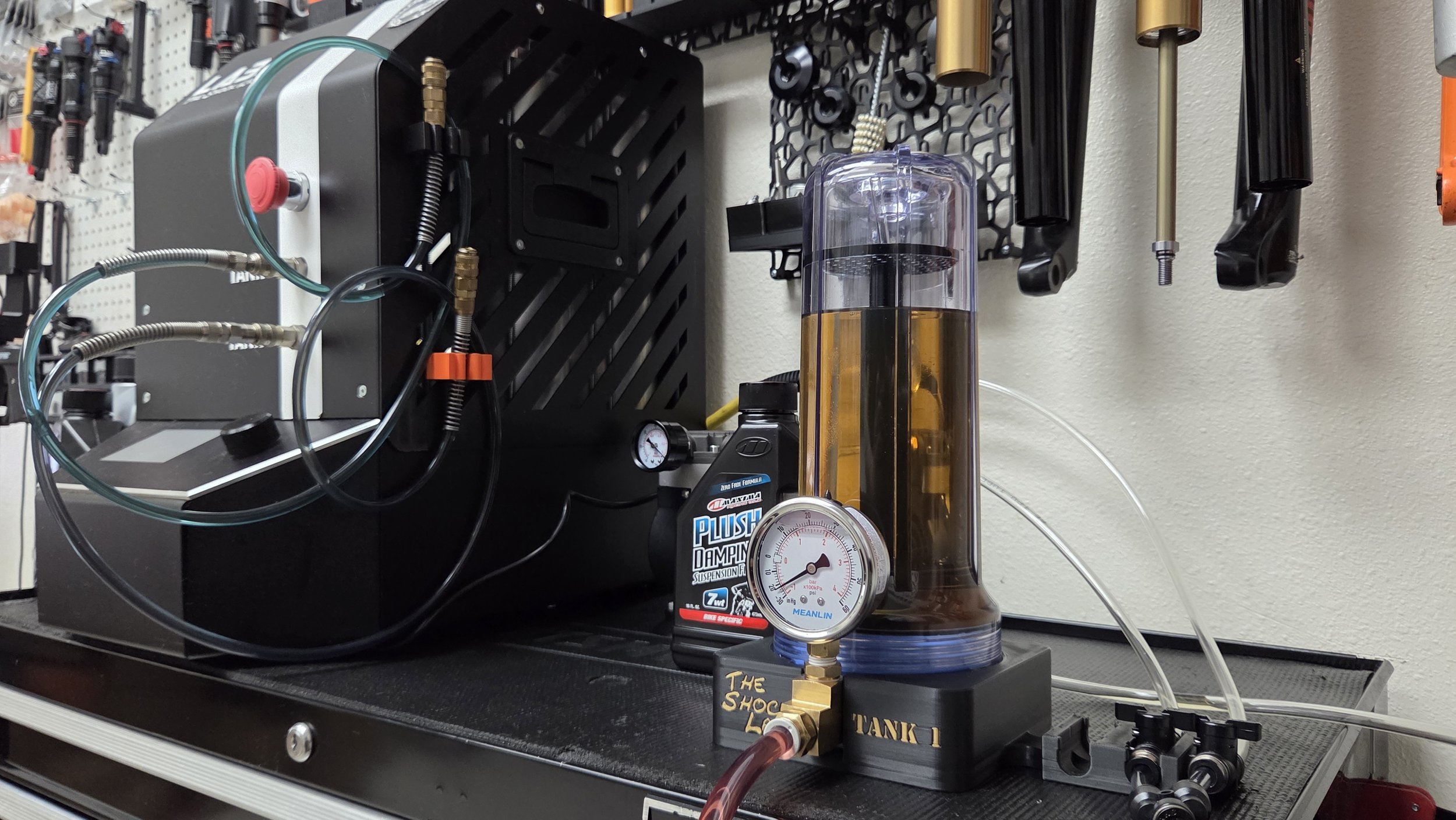
Build your own vacuum pump setup
Step by step
Here’s a detailed guide, this is only a suggested setup, you can get creative and add extra tanks and other features anytime!
-
You can find the link to everything used in our setup by clicking here. (Air compressor and hose not included).
-
This is a relatively complex process, involving pressurized oil, do it at your own risk.
Keep in mind that air bubbles rise in oil, ideally you want the tank at your shoulder height, so the shock can be below that level. -
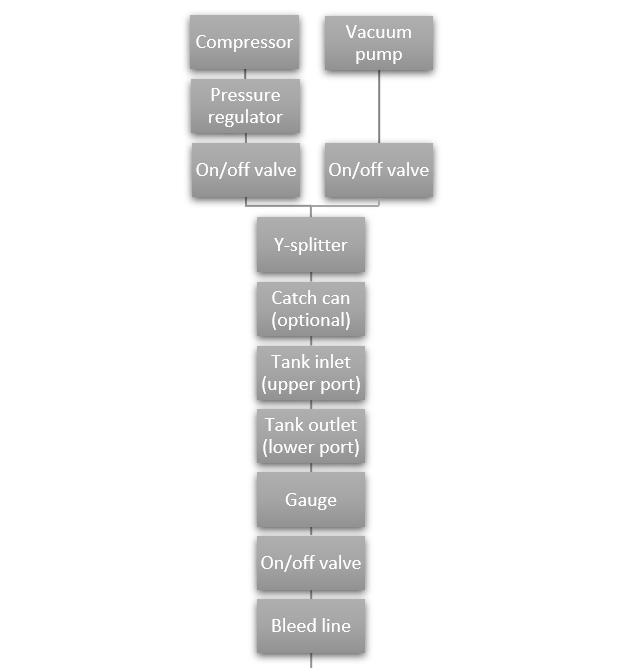
-Start by preparing your pressure line, run a hose from the compressor into the pressure regulator, and set it to 45psi. Run a piece of 8mm tubing to one of the on/off valves.
-Prepare your vacuum pump and run a piece of 8mm tubing to another on/off valve.
-Run 2 short pieces of tubing from both valves into the Y splitter.
-Run a piece of 8mm tubing from the y-splitter and prepare to plug it to the tank using a push fitting (not yet).
-Optional: Add a “catch can” between y-splitter and tank, this acts as backup to prevent oil from going into the pump.
-Crucial: Prepare your tank, press a smaller hose (~5.5mm) into the 8mm tubing, making sure it’s well sealed, and run it from one of the ports to the top of the tank using the 3D printed oil baffle. This essentially moves the port to the top.
-Install 3-way NPT fitting with Gauge and push-to-connect fitting into the other port on the tank.
-Use a small piece of tubing to add another on/off valve right after the gauge, and a longer piece of tubing to connect to the DN5 fitting, clamp recommended but not necessary.
-
*This is a fully manual system, you have full control over it, and, with great power, comes great responsibility, and danger.
*Never open the pressure and vacuum valves at the same time, this will dump the pressure into the vacuum pump and can cause damage.
*Never exceed the oil baffle level, otherwise you risk oil going into the vacuum pump.
Filling the tank
-Open the vacuum valve and turn pump on, close the valve and turn pump off. Keep an eye on the tank gauge, it should not drop, even overnight.-Once you’ve checked for leaks, plug a bleed fitting to the DN5 coupler, and sink it into an oil bottle.
-Open vacuum valve and turn pump on for a few seconds, (it does not need to stay on), turn vacuum valve off.
-When you want to stop the flow, close the valve at the tank gauge to prevent sudden pressure changes. And slowly open the vacuum valve to release pressure or vacuum.
Get familiarized with the system.
-
-Start by opening the vacuum (and tank) valve and turn on the pump for a few seconds (it does not need to stay on), close the vacuum valve and hold that vacuum for a bit.
-Slowly open the pressure valve until you reach target pressure, close the pressure valve and hold that pressure for a couple minutes, cycle the shock a few times.
-SLOWLY open the vaccum valve and wait for pressure to release, then turn vacuum pump on again for a few seconds, close the vacuum valve, hold for a couple minutes.
-Switch from pressure/vacuum a few times until there’s no more bubbles coming out of the shock. Always finish with a pressure cycle.
-Release tank pressure, set IFP height, close all valves and disconnect bleed fitting.